

PRINCIPLE OF ACTION NO. 2: THINKING WITH YOUR HANDS
This article (1/7) is part of the series Principle of Action No. 2: Thinking with Your Hands, from the collection “The Other Path.”
A few weeks ago, I lived through a small scene that had me thinking for hours afterward.

That day, sitting at a Parisian café, I was preparing a new sequence for one of our shows. I had pulled out my new “magic” laptop — a rather special device with two screens stacked on top of each other, doubling the display area. Like many of us, I was juggling between a Word document, an urgent email, and a Google search. Next to me, a man in his thirties had just sat down at the neighboring table (I’d love to claim he was 70, and that what follows came from his great wisdom, but I’d be lying to you: he was much younger than me). He pulled out a Moleskine notebook and started writing with a pen, slowly, focused on his task.
While I was frantically tapping away, switching between my two screens, the man was simply writing. At one point, he looked up at my setup and said with a half-smile: “Impressive, those two screens at once. You must have twice as many thoughts as I do… or half as much time to think them.”
I replied instinctively, faking some tech enthusiasm: “It’s very handy!” To which he immediately shot back: “That’s exactly the problem.” I decided not to respond. To be honest, I wasn’t entirely sure I’d understood his remark. And strangely, his words started to nag at my concentration. As the minutes passed, I caught myself staring at his hands as he wrote.
When he closed his notebook, after half an hour, I worked up the courage to ask him: “What exactly did you mean earlier?”
He said nothing. He opened the Moleskine, turned a page toward me with a smile, and I saw it was covered in annotations, arrows, crossed-out words rewritten in the margins. He closed the notebook and added: “Your screens always agree with you. This pen has already contradicted me three times this morning.”

The page covered in crossed-out words says something words alone couldn’t say as well: thought doesn’t come out clean. It fumbles, contradicts itself, crosses things out, starts over. That visible mess on the page is the physical trace of cognitive friction.
A Word document never shows that. The Delete key erases everything. The final text is always neat and linear, as if the thinking had been smooth from the start. The notebook, on the other hand, keeps the mistakes: it tells the story of the journey, not just the destination.
By showing me that page without a word, the man was essentially telling me: look at what your screen hides from you about your own thinking.
Friction is where thought takes shape.
He then told me about the pleasure he took in scribbling, the sentimental value his Moleskine’s leather cover held for him, a gift from an old uncle who had since passed away. The smell of the leather, the scratches, the imperfections of that cover. The stories that worn cover told turned out to be more numerous than the ones contained in the notebook’s pages. That worn cover pointed to a question I hadn’t really asked myself yet: what digital tools give us in fluidity, don’t they take away something else, something less visible, and perhaps more precious?
Why Our Digital Objects Have No Soul
A guitar played for twenty years isn’t the same guitar it was on day one. The varnish has worn away where the hand rests. The neck has taken the shape of the fingers that held it. The scratches on the body tell stories of falls, studios, stages. These marks encode into the material something no app can store: the density of a practice, the history of a relationship between a person and their instrument.
The Japanese have a word for this: wabi-sabi. The beauty of what is imperfect, incomplete, worn by time. An entire aesthetic philosophy built on the idea that the trace of time on an object is a form of richness, not a form of decay.
Our digital objects, by contrast, don’t age. They either work or they’re obsolete. Last year’s iPhone carries no trace of last year. No patina, no visible memory, no wabi-sabi. It would, however, be too simplistic to reduce this to a caricatured standoff between a rich material world and an impoverished digital one.
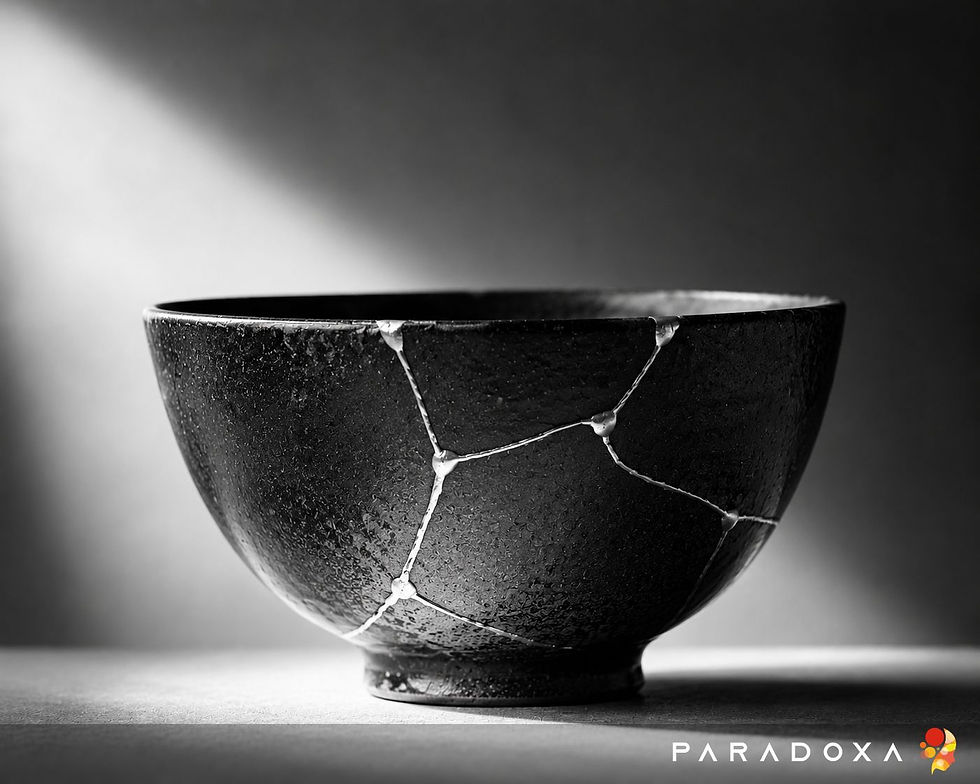
The problem isn’t the digital as such. It’s a certain use of the digital: one that eliminates all friction, all real constraint. Digital technology that only smooths things over becomes digital technology that impoverishes. Digital technology that offers resistance can, on the contrary, enrich.
The Question No One Asks
That small scene in the Parisian café crystallizes a question we almost always avoid, and one that’s become especially pressing in the age of artificial intelligence. We spend our days asking what artificial intelligence can do, what it will do tomorrow, what it will replace. That’s a legitimate question. But no one asks the symmetrical question, which is arguably the more strategic one: what will artificial intelligence probably never be able to do, at least not the way we do? And what if that second question deserved all our attention?
This article is about a loss we haven’t quite named yet: the loss of confrontation with reality. Not the reality of data and dashboards, but the reality that resists, that surprises, and that you only see in the moment, hands in the engine.
AI can analyze, synthesize, simulate, forecast. It outperforms most of us on everything that can be calculated or formalized. The territory we once thought was exclusively human is visibly shrinking. Some systems can already detect behavioral signals that experienced managers can’t perceive: micro-tonal variations in a voice, engagement patterns in a meeting, signs of disengagement in a room. And this is only the beginning: these capabilities are advancing faster than our ability to anticipate them.
But perceiving a signal and being affected by it are two radically different operations. A manager who senses a negotiation is turning doesn’t just know it through their eyes: they feel it in their body before they can put it into words. That sensation directs their attention, mobilizes their judgment, and adjusts their posture in real time. Neuroscientist António Damásio showed that bodily emotions aren’t background noise in decision-making — they’re its infrastructure. This way of being present, physically, under tension, with something at stake, can’t be reduced to signal detection, however sophisticated.
These boundaries aren’t fixed. The territory once thought exclusively human is visibly shrinking, and will keep shrinking. What durably distinguishes human presence from artificial intelligence is a body with “something to lose.” AI has no visceral stake. It doesn’t feel that inner tremor that makes a presence legible to another person. So the real question isn’t what AI doesn’t yet perceive, but what an engaged body brings to action that neither perception nor calculation can reproduce.
The principle of action I want to explore with you here isn’t a nostalgic plea for a return to candlelight and parchment. It’s about understanding what objects and practice contribute to our cognition and our creativity. And realizing that, in a world where AI excels at everything abstract and calculable, embodied skill grows more valuable precisely as AI advances.

